
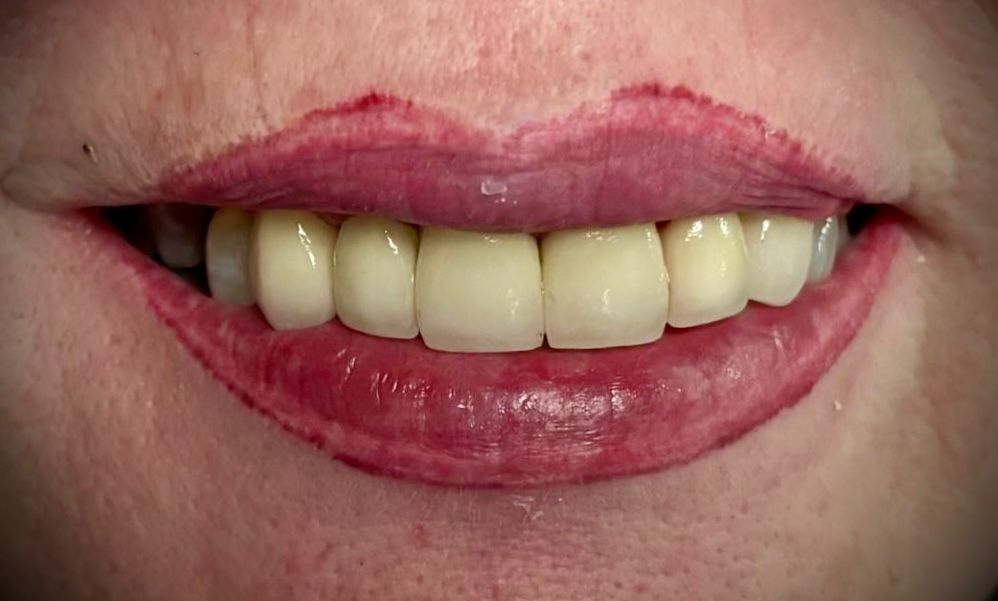
It's probably the most common question in cosmetic consultations: "I want a whiter smile — should I get whitening or veneers?" The honest answer is that these are different treatments solving different problems, and confusing them can lead you to pay far more for less result — or the opposite, to fall short of what you actually wanted.
This article walks through what each one actually does, who it's for, and how the decision should be made with clinical judgment rather than Instagram aspiration.
Whitening: changes color, not shape
Professional teeth whitening works with hydrogen peroxide or carbamide peroxide, which break the chemical bonds of the darker-colored compounds in enamel[1]. It's a chemical treatment acting on your own tooth, without modifying its shape, size, or position. According to the American Dental Association, professional treatments contain higher concentrations than over-the-counter products and deliver results faster with fewer applications[1].
Colgate Professional describes whitening as capable of lightening the natural shade of teeth by several tones, depending on the starting point and individual patient[2]. But there are three things whitening cannot do:
- It doesn't change the shape of the tooth. If your concern is chipped, worn, or misaligned teeth, whitening will not address it.
- It doesn't act on prior restorations. Crowns, old veneers, visible fillings, or inlays do not change color with the treatment — only your natural teeth do[2].
- It's not permanent. Enamel re-stains over time from coffee, tea, wine, dark sodas, and tobacco[2]. Duration varies with habits.
Is it safe for enamel?
When performed by a professional with appropriate products, or when using products with the ADA Seal of Acceptance, whitening is considered safe[1]. The real caution is around overuse: hydrogen peroxide can make enamel more permeable, and the ADA documents that repeated or aggressive use can lead to sensitivity, translucency, and — in cases of abuse — enamel erosion[1]. That is why the ADA's official recommendation is to consult a dentist before starting any whitening product, including over-the-counter options[1].
Veneers: change shape, color, and size — and they're for life
Veneers are thin shells bonded to the front surface of the tooth. Porcelain veneers, the most common choice in modern cosmetic dentistry, are ceramic and cemented adhesively with resin[3]. In doing so, they can modify color, shape, size, and apparent position — which is why they are the right option when the problem is not just tone.
Two critical points every patient should understand before committing to veneers:
1. They are, in practice, irreversible. Colgate Professional describes veneers as a permanent treatment, and the reason is that the procedure typically requires removing some of the front enamel so the veneer adheres without looking bulky[2]. That removed enamel does not grow back. Anyone who gets veneers is committed to wearing veneers (or some form of restoration) from that point forward.
2. They are durable, but not eternal. Clinical studies published in the Journal of the American Dental Association report that many ceramic systems have achieved success rates above 90% at six years for veneers[3]. That is excellent longevity compared to other esthetic treatments, but it also means they have an eventual replacement horizon.
When is each one the right choice?
This is the part that summarizes everything and rarely gets explained this directly:
Whitening is the right option if…
- Your teeth are healthy, well-aligned, and you like their shape and size.
- Your only concern is yellowing or staining from coffee, tea, wine, sodas, or tobacco.
- You do not have crowns, prior veneers, or visible restorations on front teeth.
- You want a reversible-by-non-repetition treatment — if you stop, your teeth return to their natural color.
- You are willing to maintain habits and repeat the treatment periodically.
Veneers are the right option if…
- Beyond color, you want to correct shape, size, chipping, or minor misalignment.
- You have deep stains (tetracycline, severe fluorosis) that do not respond to whitening.
- You have old restorations on front teeth and want to unify the smile.
- You seek a stable result and accept that it is a permanent commitment with your enamel.
- You understand they are not eternal and will eventually need replacement.
What is almost always a mistake is combining them in the wrong order. If you know you will get veneers, whitening the neighboring teeth first can make sense so everything matches. But whitening after cementing veneers does not affect the veneers — it only lightens the remaining natural teeth, which can break uniformity. This conversation must happen in consultation, not after the procedure.
The conversation you should have with your dentist
Before committing to either, an honest clinical review should answer together:
- What exactly is your complaint? "I want a prettier smile" is a starting point, not a diagnosis. Point to the tooth, the angle, the specific feature.
- Do you have prior restorations on front teeth? This completely changes which treatment is viable.
- How are your gums? Neither treatment is performed on inflamed gums.
- Do you have bruxism? Nocturnal grinding shortens veneer lifespan — there are specific protocols and a night guard may be needed.
- What is your maintenance horizon? If you do not plan to return for follow-ups, probably neither is for you right now.
This conversation is the most important part of the treatment. At our Monterrey clinic we run a short initial consultation where we evaluate your smile, review your history, and tell you honestly which treatment — or none — addresses what is bothering you.
Practical summary
- Whitening: changes color only, is reversible-by-non-repetition, does not act on restorations, requires periodic maintenance.
- Veneers: change color, shape, and size, are permanent (require enamel removal), last many years but not forever.
- The choice is not about budget — it's about what problem you're trying to solve.
- Both treatments require healthy gums, prior evaluation, and follow-up.
- Whitening safety is supported by the ADA when performed under professional supervision[1].
Want to know which one fits you specifically?
A 20-minute consultation with Dr. Yadira Garza helps you decide with no commitment. We are at Centro Médico Obispado, office 92, Monterrey.
Book via WhatsApp