

Professional teeth whitening: types, cost range, and what to expect
A smile matters, especially in a city like Monterrey. A photo over coffee on Calzada, a family gathering full of selfies, a job interview: your mouth speaks before you say a word. The problem is that many patients arrive at the office already tired of miracle toothpastes and internet kits that promised pearly white and left disappointment. The confusion is normal; there is too much noise and too little honest information.
In this article I explain, without embellishment, what professional teeth whitening is, what types exist in clinical practice, what you can realistically expect and what you cannot. I speak from what I see in the office every day, not from an advertisement. You will not find promises of "movie white" or impossible guarantees here; you will find clinical facts so you can decide clearly before booking.
What is teeth whitening and how does it work?
Teeth whitening is an aesthetic procedure that lightens the shade of teeth by several degrees. It is not a superficial cleaning; it is a controlled chemical process. The active ingredient is always an oxidizing agent: hydrogen peroxide or carbamide peroxide. In the office we use professional concentrations ranging from 15 to 40 percent, depending on the case and the patient's sensitivity.
What does the peroxide do inside the tooth? It penetrates the enamel and reaches the dentin, where it breaks down into oxygen molecules that fragment the organic pigments responsible for yellowing or staining. The pigment molecules do not disappear instantly; they fragment and stop reflecting that dark color, so the tooth appears lighter. It is a chemical reaction, not a scraping or grinding of the enamel; the tooth is not worn down, it changes tone. That is key to understanding why the result is neither immediate nor permanent.
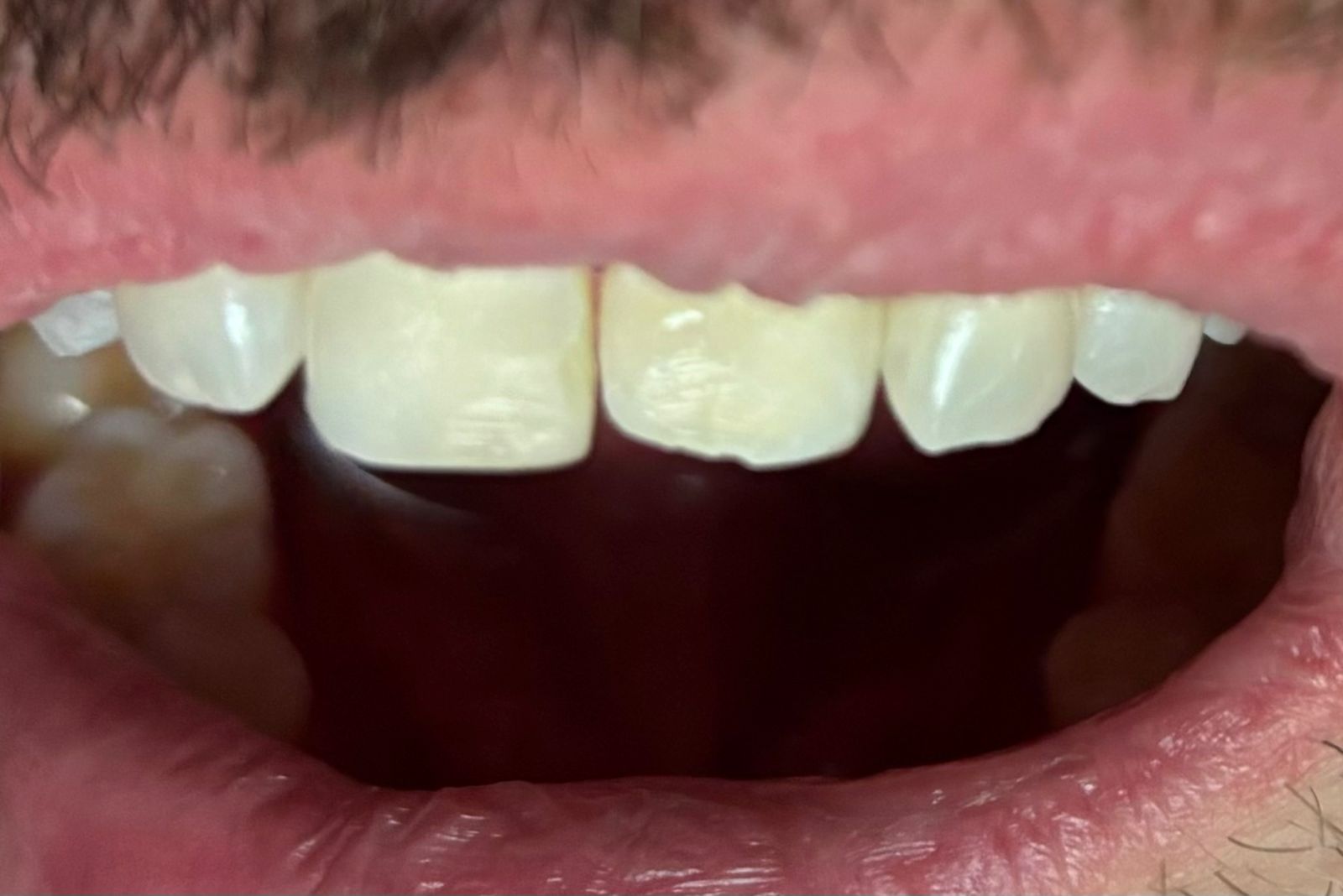
Types of professional whitening: in-office vs. take-home
There are two clinical paths and they do not compete, they complement each other. In-office whitening is done in a single session of 45 to 60 minutes. We apply the high-concentration gel over the teeth and activate it with light, usually LED. The advantage is a visible result the same day; the disadvantage is that for some sensitive teeth it can be a strain. Before any session it is always advisable to have an ultrasound cleaning, and we offer that service here at the office in Centro Médico Obispado.
Take-home whitening is the other path. We take impressions and fabricate custom trays; the patient takes home the lower-concentration gel and applies it at home, usually at night, for two to four weeks. It is more gradual, gentler on sensitivity, and lets the patient control the pace. In consultation there is no single winner: in-office accelerates, take-home accompanies. We often combine both to sustain the result. What I always say is that no method keeps a tone forever; enamel is exposed all day to coffee, the Monterrey sun, and time.

Is it safe to whiten your teeth? Risks and candidacy
Professional teeth whitening is a safe procedure when performed on healthy gums, without active cavities, and with enamel in good condition. Before starting any treatment, we evaluate case by case in the office: we check periodontal health, rule out untreated cavities, and verify there are no deep cracks or unresolved hypersensitivity. If any of that is present, we first treat the underlying problem and then evaluate whitening. There is no point in whitening a tooth that is diseased.
There are situations where we do not recommend it. During pregnancy and breastfeeding we prefer to wait; although there is no conclusive evidence of harm, clinical prudence prevails. In minors under 18 without a specific indication it is also not appropriate, because the enamel is still maturing and the pulp is wider. The most frequent risk, even in ideal patients, is transient sensitivity: mild discomfort to cold or heat for a few days after the procedure, managed with desensitizers and disappearing without sequelae. This can only be confirmed in a clinical review, where we determine whether you are a candidate or whether something else needs attention first.
In-office whitening vs. home kits: real differences
Over-the-counter home kits — strips, pharmacy gels, generic trays — use low peroxide concentrations, generally between 3% and 14%. That translates into a limited result: they can lighten one or two shades in the best cases and require weeks of disciplined use. The problem is not only the potency, but the application. A tray that is not custom-fit can leave the gel poorly distributed, generate uneven whitening, or worse, allow the product to touch the gum and cause irritation. The risk of gingival damage with poorly fitted kits is real, and we see it in the office when someone arrives with gums injured by a product that did not fit them well.
Professional whitening, on the other hand, uses controlled-quality gel with concentrations only available in the clinical setting. Before applying, we place a protective barrier over the gum that completely isolates it from the peroxide, and the process is done under direct supervision. That allows controlling the amount, contact time, and tooth response at every moment. If sensitivity appears, we adjust. If something goes wrong, we stop. The difference is not in the ingredient, which is the same peroxide, but in how it is administered and who monitors it.
Approximate cost of teeth whitening: what influences the price
As a general reference for Monterrey, in-office whitening moves in an approximate range of $8,000 to $15,000 MXN, and the take-home option — custom trays with gel for home use — runs between $4,000 and $8,000 MXN. These are not fixed figures; they are an orienting framework so you arrive with a realistic idea and are not caught off guard. Several factors move the price: the type of gel we use, the number of sessions your case needs, clinical complexity — a case with tetracycline stains is not the same as simple coffee yellowing — and the combination of both modalities, which in many cases gives a better result than either alone.
The real price comes after a clinical evaluation, because that is where we define what your specific smile needs. One patient may need a single session, another may benefit from in-office plus take-home to maintain the result. That plan defines the cost, not a menu of options. That is why, before quoting, we review the state of your teeth and gums, identify the cause of darkening, and build the approach that makes sense for you. Honesty here is simple: a price without an evaluation is a lottery, and in oral health you do not roll the dice.
Post-whitening care: how to maintain the result
Whitening does not end when you leave the office. The first 48 hours are decisive because the enamel is temporarily more porous and absorbs pigments easily. During those two days it is advisable to follow a white diet: rice, chicken without marinades, bread, dairy, banana, apple without skin. Avoid coffee, tea, red wine, dark sodas, soy sauce, berries, beets, ketchup, and of course tobacco. It is not forever, but those two days matter.
After 24 hours you can resume your normal hygiene with gentle brushing and a desensitizing toothpaste if you notice discomfort. Periodic professional cleanings with ultrasound, which we perform routinely here at the Obispado office, help remove surface stains before they set and prolong the result. Not smoking is the measure that impacts the most long term: tobacco not only stains, it also compromises the health of gums and tissues. With these cares whitening lasts much longer and your investment pays off better.
Tooth sensitivity after whitening: what to expect and how to manage it
It is normal to feel some sensitivity during the first 24 to 72 hours. The peroxide temporarily opens the enamel tubules, which makes the teeth respond with greater intensity to cold, heat, and sometimes acidic foods. It is not a complication; it is a transitory effect of the process. Most patients describe it as mild discomfort, not pain, and it usually resolves on its own in one to three days.
To manage it, a toothpaste with potassium nitrate and topical fluoride helps block the sensation in the tubules. Avoid extreme foods and beverages during those days. If the discomfort warrants it, you can take paracetamol as indicated. The important thing is to communicate with your dentist if sensitivity persists for more than three days or increases rather than decreases; sometimes the protocol needs adjustment or another underlying cause needs to be ruled out. This can only be confirmed in a clinical review.
Want to know if you are a candidate for teeth whitening?
Schedule your evaluation via WhatsApp and we will discuss your case with no commitment. We will honestly tell you whether whitening suits you or whether there is a better option for your smile.
Book via WhatsAppDra. Yadira Garza — Dental Surgeon, UANL. 22 years of clinical experience. Professional license 4520593. Private practice at Especialidades Dentales, Centro Médico Obispado, Monterrey.
This article is for informational purposes only and does not replace a professional consultation.