

You lean in to say hello and the other person takes a step back. Or you check your mouth mid-morning and notice that stale taste brushing didn't take care of. At our Especialidades Dentales office in Centro Médico Obispado, bad breath is one of the complaints we hear most often, usually mentioned in a whisper: it's embarrassing to bring up, yet it affects your confidence at work and with your partner.
Here's the part few people tell you: the vast majority of bad breath cases don't come from the stomach. They come from the mouth. And inside the mouth, it's almost always something that can be fixed: inflamed gums, built-up tartar, untreated cavities, or a tongue that never gets cleaned. In this guide I'll explain where the odor comes from, how to tell whether it's your problem, which treatments exist, and which habits keep it under control.
What is halitosis and why does it show up?
First, a distinction that saves you unnecessary worry: passing breath odor is normal. Morning coffee, the garlic in your weekend carne asada, or a night of sleeping with your mouth open all fade once you brush. Halitosis is different: a persistent bad odor, the kind that comes back within minutes of brushing. The mechanism is bacterial: your mouth hosts hundreds of bacterial species that, as they break down food debris and proteins in saliva, release volatile sulfur compounds — the same ones that give rotten eggs their smell. The useful question isn't whether you have bacteria (everyone does), but where they concentrate unchecked.
Dental causes: tongue, gums, tartar, and dry mouth
In our practice we see the same culprits over and over. From most to least common:
- The tongue. The back of the tongue is rough and moist: the favorite refuge of sulfur-producing bacteria, and the single most frequently cited source of odor inside the mouth in the clinical literature. An uncomfortable truth: many people "clean" their tongue by rubbing it against their teeth or the roof of their mouth, which barely reaches the tip. The area that matters is in the back — exactly where the coating looks white or yellowish.
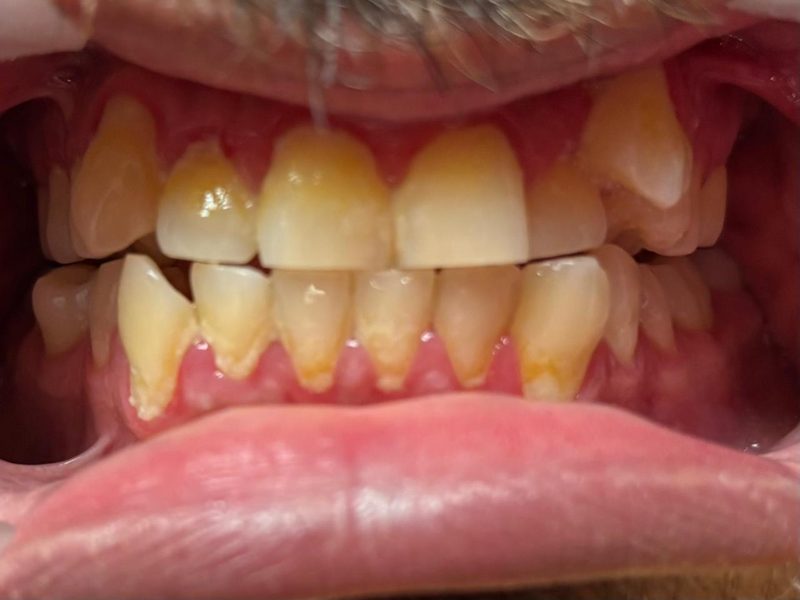
- Inflamed gums and tartar. Plaque that isn't removed by brushing hardens with minerals from saliva and forms tartar (dental calculus). Its rough surface traps even more plaque and keeps the gums inflamed. When that inflammation advances, periodontal pockets form: deep spaces between tooth and gum where debris collects that a brush can never reach. That's why persistent bad breath is one of the classic signs of gum disease, along with bleeding and recession.
- Deep cavities and worn restorations. A tooth with a cavity traps food debris and bacteria; an old filling that no longer fits leaves gaps where plaque concentrates. Each one is an odor reservoir that brushing can't reach.
- Dry mouth. Saliva is your mouth's natural cleaning system: it constantly washes away bacteria and debris. When saliva drops — because of medications, mouth breathing, or simply at night — odor concentrates. That's why morning breath is the heaviest, and why people with chronic dry mouth often have background halitosis.
Quick tip: scrape your tongue every night. Stick your tongue out, place the scraper (or your brush) as far back as you can without gagging, and pull forward with 3 or 4 gentle strokes. Rinse the scraper between strokes. It's the single habit with the best effort-to-result ratio against bad breath of oral origin — and the most forgotten.
Can it come from the stomach? Myths and realities
It's the million-dollar question, and the honest answer is: almost never. Most cases of halitosis originate in the mouth, not the digestive system. Under normal conditions the stomach is sealed by a valve that keeps odors from rising; "stomach breath" is associated with specific and uncommon clinical situations, not everyday bad breath.
What does exist is a link with gastroesophageal reflux: acids that travel up the esophagus can change the environment in your mouth, add odor, and contribute to enamel erosion. And in medicine there are breath odors tied to specific systemic conditions — for example, an acetone-like smell during uncontrolled diabetes. Those are defined clinical cases, not day-to-day bad breath.
The practical takeaway: if your bad breath is chronic, the first step is a dental checkup, not a digestive workup. Start where the statistics are.
Signs the bad breath comes from your mouth
Noticing it yourself is hard: your brain gets used to your own smell. These clues point you in the right direction:
- Constant mints and chewing gum: if the odor comes back within minutes of brushing, there's an active cause.
- A stale or metallic taste when you wake up or in mid-afternoon, one that mouthwash doesn't fix.
- The back of your tongue looks white or yellowish in the mirror.
- Bleeding when you brush or floss: a sign of gum inflammation, a frequent cause of halitosis.
- An unpleasant odor right after flossing between two teeth: that's concentrated plaque.
- Someone you trust has told you — or hints that you step back when you talk.
None of these signs is a remote diagnosis: the exact source is only confirmed in a clinical exam of the tongue, the gumline, and saliva.
Dental treatments and habits that eliminate bad breath
Treatment depends on the cause we find during the exam, and the logic is the same as with any gum problem: first remove the cause, then keep it under control. The most common options:
- Prophylaxis (professional cleaning). With ultrasonic instruments, tartar is removed above and below the gumline. If the source is tartar and early inflammation, one well-done session plus your routine at home is usually enough, with steady improvement in the days after the procedure.
- Scaling and root planing (deep cleaning). When inflammation has already formed periodontal pockets, a regular cleaning can't reach them: the area is numbed, cleaned below the gumline tooth by tooth, and the roots are smoothed so the gum can reattach. It's the definitive treatment when the odor comes from periodontitis.
- Treating cavities and restorations. Every active cavity gets restored and every worn filling gets checked, because they are reservoirs for bacteria and debris.
- Managing the tongue and dry mouth. Daily tongue scraping; and if there's dry mouth, the causes are reviewed — medications, mouth breathing, snoring — in coordination with your physician when appropriate.
And at home, the habits that sustain the result:
- Brushing twice a day with proper technique: soft brush, angled 45 degrees toward the gumline, short strokes. Scrubbing hard doesn't clean more — it damages.
- Flossing once a day, ideally at night: what's left between your teeth ferments all night long.
- Nightly tongue scraping, using the technique from the tip above.
- Water often: Monterrey's dry climate and air conditioning dry out your mouth, and saliva is your ally.
- Chlorhexidine rinses only for short periods and under professional guidance: they help when inflammation is significant, but prolonged use stains teeth and doesn't replace brushing.
Book a checkup if bad breath persists beyond two weeks despite complete hygiene including tongue scraping, if your gums bleed, or if you notice gum recession or loose teeth. During the visit we evaluate the surface of the tongue, the gumline, the condition of your restorations, and your salivary flow. That defines the source and the treatment; in the minority of cases where the mouth is healthy, we coordinate a medical referral to look into other sources.
Questions our patients ask most
Why is bad breath worse in the morning?
Saliva production drops overnight, your mouth dries out, and bacteria produce more sulfur compounds. It gets worse if you sleep with your mouth open or snore. Tongue scraping before bed and nighttime brushing reduce morning breath considerably.
How can I tell if I have bad breath if nobody tells me?
Your brain gets used to your own smell, so it's hard to detect on your own. Licking your wrist and smelling it once it dries gives a rough reference; checking the back of your tongue in a mirror and asking someone you trust points you in the right direction. No one can confirm it from a distance: the clinical exam settles it.
Can bad breath come from the stomach?
Usually not. Most cases originate in the mouth: on the tongue, in inflamed gums, or in untreated cavities. Reflux can contribute in some patients, and there are systemic conditions with distinctive odors, but they are exceptions. That's why the first step is a dental checkup.
Does mouthwash fix halitosis?
A regular rinse freshens for minutes and doesn't correct the cause. Chlorhexidine rinses help when inflammation is significant, under professional guidance and for short periods. If you depend on mouthwash every day, there's an untreated cause: it's time for a checkup.
What dental treatment applies?
It depends on the exam: from an ultrasonic prophylaxis if there is tartar, to scaling and root planing if there are periodontal pockets, or treating cavities and worn fillings. The plan is defined by the diagnosis in consultation, not the pharmacy counter.
Practical summary
- Chronic bad breath is, in the vast majority of cases, of oral origin — not from the stomach.
- The most common culprits: the back of the tongue, inflamed gums with tartar and periodontal pockets, cavities, and dry mouth.
- Nightly tongue scraping, daily flossing, and staying hydrated are the habits with the biggest impact.
- If the odor persists more than two weeks with good hygiene, book a checkup: the exact source is only confirmed in consultation.