
You look in the mirror, you smile, and something doesn't quite convince you. It's not that your teeth are bad —but those small gaps, that slight crowding on the bottom teeth, or that bite that doesn't quite fit together the way it should make you hesitate. You've heard of Invisalign and clear aligners, but you're not sure whether they really work or whether they're just a passing fad for celebrities.
As a dentist with more than 22 years of experience in Monterrey, I've seen many patients come into the office with that same doubt. The good news is that clear aligners are a real, clinically proven option and, for many cases, the best alternative to traditional braces. But —and this is important— they are not for everyone. In this article I explain honestly how they work, what advantages and disadvantages they have, how much they cost, and how long they take, so you can make an informed decision.
What is Invisalign and how do clear aligners work?
Invisalign is an invisible orthodontics system that uses a series of custom-made plastic aligners —each one slightly different from the previous one— to move your teeth gradually toward their ideal position. They aren't the only aligners on the market, but they are the most recognized brand, with the greatest clinical and technological backing.
The process begins with a digital scan of your mouth —without those gooey molds that make you gag—. That scan is processed with specialized software (Invisalign's ClinCheck), which generates a 3D treatment plan: you can see how your teeth will move, stage by stage, before you even start. Once you approve the plan, your custom aligners are fabricated in a laboratory, and you switch them approximately every 1 to 2 weeks as directed by your dentist.
Each aligner applies a controlled, precise force on the teeth that need to move. It isn't magic —it's pure biomechanics, the same science behind braces, but with a different force application system. The aligners are made from a multilayer plastic material (SmartTrack, in Invisalign's case) that is flexible, transparent, and strong enough to maintain constant pressure during the days you wear them.
A key difference from braces: aligners are removable. You take them out to eat, to brush your teeth, and to clean them. This means no food restrictions like with braces (where corn on the cob, nuts, or gum are forbidden territory), and oral hygiene is much simpler. But it also means the success of the treatment depends on your discipline: if you don't wear them enough hours, your teeth won't move the way they should.
Invisalign vs. traditional braces: a real comparison
If you've already read our article on traditional braces vs. invisible aligners, you know there's a general comparison. Here I want to go deeper into the practical difference the patient feels day to day.
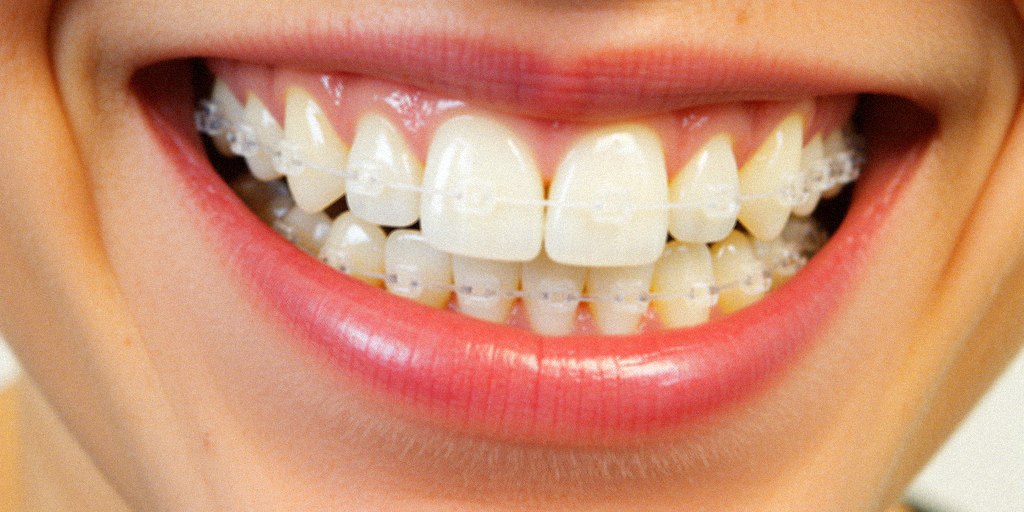
In terms of aesthetics, aligners are virtually invisible at a normal social distance. No one will notice you're wearing them unless they look very closely. White ceramic braces (like those in the image) are an intermediate option —less visible than metal ones, but not as discreet as aligners—.
As for comfort, aligners win in day-to-day life: there are no wires poking your cheek, no ligatures coming loose, and dental visits are usually less frequent (every 6-8 weeks vs. every 4 weeks with braces). However, the first few days with each new aligner can cause pressure and sensitivity —it's normal; it means they're working—.
Where braces still win is in high-complexity cases: severe molar rotations, significant vertical movements, or posterior crossbite corrections. Aligners have improved a lot, but for certain complex movements, metal braces remain more predictable. Honesty here is fundamental: if your case requires movements that aligners can't reliably achieve, I will tell you so.
Who is an ideal candidate for clear aligners? (and who isn't)
This is probably the most important section of this article, because the biggest frustration I see in the office comes from patients who bought aligners online or at clinics that didn't properly evaluate their case, and after months of use they see no results.
You ARE an ideal candidate if:
- You have mild to moderate crowding (teeth that are crowded but without severe rotations).
- You have gaps between your teeth (diastemas) that you want to close.
- Your bite is acceptable or requires minor corrections (mild overbite, mild open bite).
- You have the discipline to wear the aligners 20-22 hours a day (yes, it's an almost total commitment).
- You are an adult or a teenager with all permanent teeth erupted.
- You have healthy gums or your periodontal disease is under control.
You are probably NOT an ideal candidate if:
- You have severe rotations in molars or premolars (more than 20 degrees).
- You need multiple extractions as part of your orthodontic treatment (although Invisalign can handle some extraction cases, it's more complex).
- You have a posterior crossbite that needs skeletal correction.
- You are not willing to wear the aligners almost all day (less than 20 hours = failed treatment).
- You have severe, uncontrolled bruxism (you can break the aligners).
The only way to know for sure whether you're a candidate is with a clinical evaluation. A scan and a review of your bite, gums, and bone tell us in a single visit whether aligners are right for you or whether you need braces. Don't assume anything without that evaluation.
How much does Invisalign cost: factors that determine the price
Let's talk about money with transparency. The price of Invisalign treatment in Monterrey depends on several factors that you should understand before making a decision.
The cost of the treatment is determined mainly by:
- Case complexity: A mild case (5-7 aligners per arch) costs less than a moderate or complex case (20-30+ aligners). Invisalign classifies cases into levels (Lite, Moderate, Comprehensive), and the price rises with each level.
- Number of aligners needed: More aligners = more material and more laboratory time.
- Refinements: At the end of the initial treatment, it's common to need additional adjustment aligners (refinements) to fine-tune details. Some treatments include them; others charge for them separately.
- Final retainers: When the treatment ends, you need retainers to keep your teeth in their position. Check whether they are included in the price.
- Checkups and follow-up: The review visits during treatment. At our office they are included in the comprehensive plan.
In general terms, investing in Invisalign in Monterrey represents a higher cost than traditional metal braces orthodontics, and is comparable to or slightly higher than ceramic braces. It's an investment in comfort, aesthetics, and fewer office visits.
How long does aligner treatment take: a realistic timeline
Treatment time varies as much as each patient, but here I give you real ranges based on what I see in the office:
Mild cases (small gaps, minimal crowding): 6 to 9 months. These are the fastest cases, where aligners shine —few aligners, visible changes early, and results that motivate you to stay disciplined—.
Moderate cases (moderate crowding, mild overbite, bite correction): 9 to 15 months. This is the most common range. Most of my Invisalign patients fall here.
Complex cases (severe crowding, multiple corrections): 15 to 24 months. In these cases, aligners can work, but they require more patience and possibly refinements at the end.
It's important to understand that the timeline depends 90% on you. If you wear the aligners 22 hours a day, switch them on schedule, and attend your checkups, the treatment progresses as planned. If you wear them 16 hours, skip days, or forget to switch them, the treatment takes longer —and sometimes teeth move in unwanted directions—.
Care during treatment: what to eat, what to avoid, and how to clean your aligners
One of the great advantages of aligners is that you take them out to eat. There are no food restrictions like with braces. You can eat your grilled meat, your tacos, your corn on the cob —whatever you want—. But there are care rules you must follow:
Aligner hygiene:
- Rinse them with lukewarm water and a soft brush every time you take them out. Don't use abrasive toothpaste —it scratches the plastic and makes them cloudy—.
- Use cleaning tablets (like Retainer Brite or Invisalign Cleaning Crystals) 2-3 times a week for a deep clean.
- Never wash them with hot water —they can warp and will no longer fit—.
- Always store them in their case when you're not wearing them. Losing them is aligner patients' number one problem.
What you should avoid:
- Smoking with the aligners in: It yellows and damages them. If you smoke, take them out.
- Drinking coffee, wine, or colored drinks with the aligners in: They stain them. Only water while you're wearing them.
- Chewing gum with the aligners in: It sticks to them and damages them.
Oral hygiene: Since you take the aligners out to eat, you can brush and floss normally. In fact, hygiene with aligners is much better than with braces, where the wires and brackets make cleaning difficult. Take advantage of this: brush after every meal before putting the aligners back in. If you can't brush, at least rinse with water.
And an important reminder: during orthodontic treatment, we recommend an ultrasonic professional cleaning every 4-6 months. At our office in Centro Médico Obispado we offer this service —aligners don't prevent tartar from building up, and keeping your gums healthy is essential for the treatment to work—.
Results you can expect: before and after Invisalign treatment
Results with Invisalign are real and predictable when the case is well selected and the patient is disciplined. What you can expect:
Aligned teeth: The crowding is resolved, the gaps close, and your smile looks more harmonious. The ClinCheck plan shows you the expected result before you start, so there are no surprises.
Functional improvement: If you had a bite that didn't fit together well, correcting it improves force distribution when chewing, which in the long term protects your teeth from abnormal wear and reduces temporomandibular joint (TMJ) problems.
Maintaining the results: At the end of active treatment, you need retainers. Teeth have memory and tend to drift back to their original position if they aren't held in place. The retainers can be aligners you wear only at night, or a fixed retainer (a thin wire bonded behind the lower teeth). This step is NOT optional —without retention, the treatment comes undone over the years—.
I want to be honest about something: aligners aren't perfect for everything. In some cases, the final results require a refinement —additional aligners to fine-tune details that weren't achieved in the initial plan—. This is normal and doesn't mean the treatment failed; it's part of the process of perfecting your smile. Approximately 70-80% of cases need at least one refinement.
Frequently asked questions
Does Invisalign hurt?
It isn't pain, it's pressure. The first 2-3 days with each new aligner you feel pressure and sensitivity when biting —it's normal and it means your teeth are moving—. After a few days, the sensation disappears until the next switch.
Can people tell I'm wearing aligners?
At a normal social distance (1 meter or more), no. Up close, a subtle shine on the teeth may be visible. No one will notice you're wearing them unless you tell them.
Can I wear them only at night?
No. The treatment requires 20-22 hours a day. Wearing them only at night isn't enough for your teeth to move as they should. If you can't commit to that wear time, braces are a better option for you.
Do they work as well as braces?
For most mild to moderate cases, yes. For complex cases (severe rotations, large vertical movements), braces remain more predictable. The clinical evaluation determines which option is better for your case.
What happens if I lose an aligner?
Contact your dentist immediately. Sometimes you can use the previous aligner while the replacement is made. Don't go more than a few days without wearing one —your teeth can shift and the next aligner will no longer fit—.
Is Invisalign right for you? Find out in a consultation
If you're considering clear aligners but don't know whether you're a candidate, the best way to find out is with a professional evaluation. In a single visit we can take a scan of your mouth, review your case, and tell you honestly whether Invisalign is the right option for you.
Book your assessment on WhatsApp →